Why a Street Feels Narrower at the Doorway
Why a street feels narrower at the doorway: see how recessed entrances and projecting details frame your view, and learn to read a street’s changing edges.
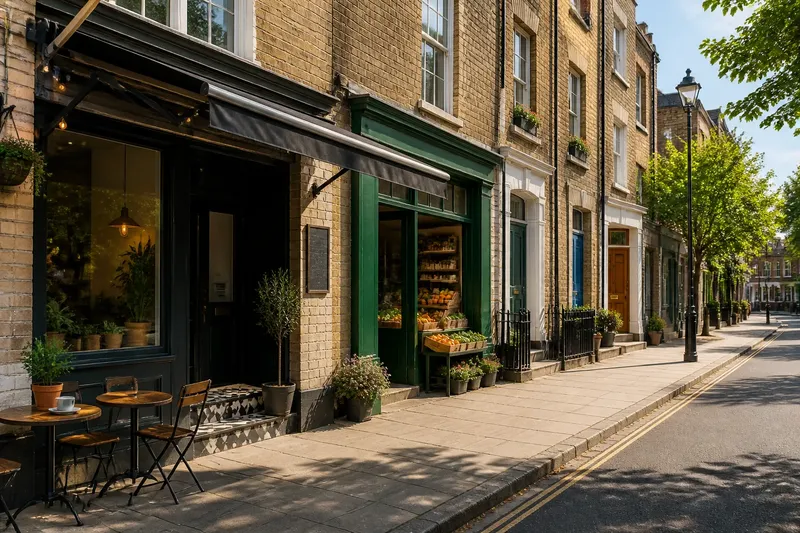
A recessed doorway can make a street feel narrower without taking space from the pavement. On a walk, the dark opening, its outer frame and any canopy above it create a cluster of nearby edges; the clear route may stay unchanged while your view feels more enclosed.
Say you are walking along an invented neighbourhood street called Alder Lane, past a café, a grocer and a row of homes. The pavement seems open from the corner but tighter beside the café. To work out why, follow the building line: note what projects, what sits back and where the view is framed.
Reading the approach
From a corner, a long, unbroken frontage can read as one calm plane. Doors, window bays and signs divide it into smaller visual units, giving the eye more nearby edges to register. That change in rhythm can make a stretch feel enclosed even when the walking path remains clear.
On Alder Lane, imagine that the café door sits behind the shopfront, beneath a narrow canopy. Approaching from the corner, you notice the canopy’s outer line, then the shadowed opening and the door. The entrance stands out as a small, layered feature rather than a flat part of the wall.
Keep the physical route separate from the visual impression. Your feet may follow a straight, unobstructed pavement while the frontage appears to press closer at one doorway. That contrast helps explain why a street can feel intimate in one spot and open again a few paces later.
Repeated doorframes
One doorway interrupts a wall; several in close succession establish a rhythm. Each frame marks a threshold and gives the eye a vertical edge. Frequent entrances can make a frontage feel lively, but tightly spaced frames may also make the street seem more like a sequence of short scenes than one broad corridor.
In the invented Alder Lane scene, the café door is followed by a grocer’s entrance and two residential doors. One has a stone surround, another sits flush with the brick, and a third has a glazed panel that reflects the pavement. Notice how the materials and spacing affect the rhythm: broad blank stretches let the eye rest, while closely grouped frames keep it moving from edge to edge.
Look at both sides of the street, if it is safe and convenient to do so. Frequent, strongly outlined entrances on opposing frontages can make the space between them feel more like a passage. The effect depends on the whole composition, not simply on the number of doors.
Projections and recesses
A building line is the general plane made by the fronts of buildings. Canopies, porches, bay windows, fascias and projecting upper floors interrupt that plane. Their outlines can make the frontage seem to step towards you, even when they leave the pavement clear.
Contrast matters. A dark canopy against pale brick has a crisp edge; a feature in a similar colour may blend into the wall. Shadows beneath a lintel or window ledge can also make a shallow detail look deeper. Notice the edge and its contrast rather than trying to judge its exact depth.
A recess has a different effect: it adds another layer behind the outer wall. From one viewpoint, that depth gives the façade character; from another, a run of shaded entrances can make the street edge feel more continuous and enclosed. It is not worth estimating every projection or turning a stroll into a building survey. A brief note such as “canopy, recess, bay” is enough to preserve the pattern.
Changes along the frontage
Where two buildings meet, the street edge may step forward or back. A shop can sit close to the pavement while its neighbour has a small forecourt or recessed entrance. A corner building may turn away and reveal a side street. Each shift changes the boundary you see as you walk.
Imagine the grocer’s façade on Alder Lane sitting behind the café’s. From across the street, the gap reads as a small widening. Walking beside it, the café canopy and the grocer’s recessed door arrive in quick succession, so the same spot can feel more enclosed. The angle of approach changes which edge catches your attention first.
A glance down the street compresses depth: entrances seem closer together, and projections may overlap. Walking along the frontage reveals their order. Turn back when you have a clear place to pause; the reversed sequence can make a different feature frame the view.
A focused street walk
On the invented Alder Lane walk, start at the corner and follow one side of the street at an ordinary pace, without blocking doorways or other pedestrians. At the café, note the canopy and recessed door; at the grocer, check whether the wall sits on the same line. Continue until the frontage changes, then pause somewhere clear to look back.
- Canopy: Check whether its outline projects beyond the wall; if it creates a strong edge in your view, note where that impression begins, then compare it with the bare wall nearby.
- Door recess: Check whether the door sits behind the shopfront; if the opening reads as a dark pocket, note the contrast, then compare it with a flush entrance.
- Entrance spacing: Check whether several doors appear close together; if the frames form a quick rhythm, note where it starts, then look for a blank stretch that gives the eye a pause.
- Bay or porch: Check whether it breaks the wall plane; if it draws your eye forward, mark its position in the sequence, then compare the view from farther along.
- Building line: Check where the frontage steps back or forward; if the shift changes the apparent width, note the viewpoint, then see whether it reads differently from across the street.
- Return view: Check which feature frames the street when you turn around; if the order changes your impression, sketch the sequence, then keep the two directions distinct in your notes.
Say your invented walk begins at the café, where you note a projecting canopy and a set-back door; the grocer sits slightly behind it, followed by closely spaced residential entrances. You then pause beyond the homes and look back. Your notes show a mostly steady building line, interrupted first by the canopy, then by the grocer’s recess and the doorframes. The result is a clear explanation for the felt change: the eye meets several distinct edges in succession, while the walking route remains open. Looking back, the residential doors now arrive first, so the café no longer dominates the view.
Why does a doorway change the view?
Can a recessed door make a street feel tighter?
Yes. The set-back door sits behind the outer wall, adding a shadowed layer that makes the entrance more prominent. The effect is visual; it does not by itself mean the pavement is narrower.
Do projecting signs or canopies narrow the pavement?
They can change the apparent width by adding a visible edge to the frontage. Notice whether the feature alters your view of the route or simply sits above it.
Why does the street feel different on the return?
The order of doorways and projections reverses, so a different feature may frame the view ahead. Light, reflections and the angle of approach can also change which details stand out.
What should I record during a walk?
Note the sequence of entrances, projections and changes in the building line, as well as where the street seems most open or enclosed. A few words or a simple sketch can capture that pattern without cataloguing every façade detail.
Edges in sequence
The useful result of the Alder Lane walk is not a verdict that the street is narrow or wide. It is a specific account of where the edges gather: at a repeated doorframe, beneath a canopy or where one building steps back. That gives you a way to compare one short stretch with the next.
Why a street feels narrower at the doorway often comes down to the order in which its details appear. Follow the building line past one entrance and note what frames the next view. If the street still feels tight, check whether the impression comes from the frontage or from anything that actually obstructs the walking route.