The Bench Facing Nowhere: A Common Seating Assumption
Bench orientation shapes views, conversation and the feeling of pause. Compare path-facing, inward-facing and oblique seating to choose a place people can use.
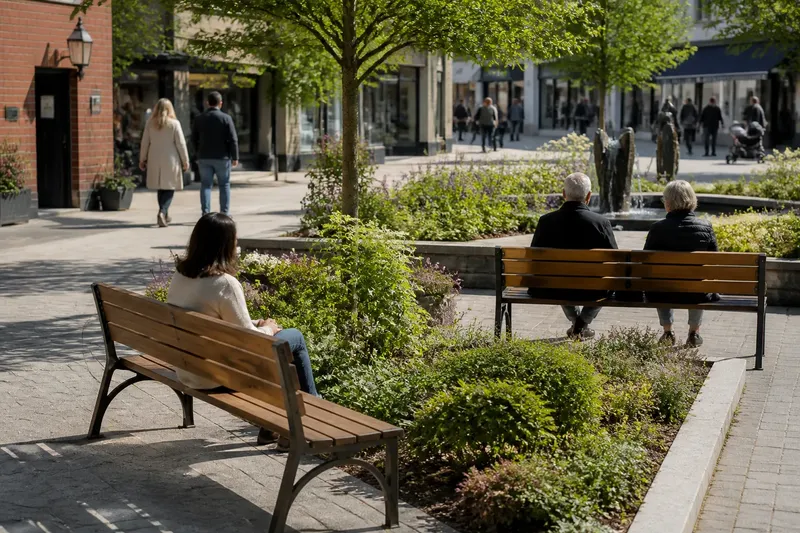
A bench does not need to face the main path to work well. In a small public space, turning its seat towards a garden edge, a companion or an oblique view can make a short pause feel less like waiting beside a thoroughfare. The right direction depends on what the space invites people to do.
Path-facing benches are easy to understand: sit down, watch the street, and remain part of its movement. But that is only one kind of use. A seat can also support a conversation, offer a moment apart from passing feet, or let someone look at a tree, a brick wall or the shifting light across a square. Orientation sets those possibilities before anyone sits.
What orientation changes
Turn a bench and its view changes, but so does its social character. Facing a path places a sitter in the flow of public life. Facing another seat or a shared feature gives people an invitation to acknowledge one another. Turning towards a quieter edge can create a small pocket of retreat without enclosing it.
These are not rigid rules. A person sitting alone may enjoy the company of street activity; two friends may prefer to watch it together rather than face one another. Still, the direction of the seat affects what feels natural. A bench aimed at a busy route can make conversation feel exposed, while one angled towards a blank wall may seem oddly withdrawn from the rest of the space.
Notice the view from sitting height, not only from the pavement. A planting bed that looks lush while standing may disappear behind a low wall once someone sits. Conversely, a modest detail—a shop’s painted side door, a row of tree trunks or the edge of a fountain—may become the most compelling feature when framed from the bench.
Facing the main path
A path-facing bench suits places where watching activity is part of the pleasure: a high street square, a promenade, a market edge or a broad pavement beside a lively frontage. It lets people keep track of companions, street performers or an approaching bus without repeatedly turning around. It can also feel welcoming to someone who wants to sit alone while remaining connected to the neighbourhood.
The trade-off is that the seat may feel like a spectator’s row. People walking close by become the main view, and sitters may feel watched in return. If the route is narrow, a bench can also draw bodies and bags into the pedestrian stream. A little space behind the seat and a clear route past its ends help the setting feel less like an obstacle, though the exact arrangement depends on the place.
Path-facing works best when there is something worth watching and enough room for sitting to coexist with movement. It is less persuasive where the route is fast, noisy or visually monotonous. In those conditions, a bench aimed directly at the pavement may offer little beyond a place to wait.
Facing a shared feature
An inward-facing arrangement directs attention towards a garden, a play area, a water feature or another seat. It suits people who come in pairs, caregivers keeping an eye on children, and visitors who want a pause centred on a particular part of the space. It can make an open plaza feel like a place to gather rather than a corridor to cross.
Conversation is more likely when seats face one another or sit around a shared feature, but a direct face-to-face arrangement can feel formal to strangers. A slight angle often makes the invitation softer: sit alongside someone, share the view, and talk if it feels natural. For a larger group, several seats around a focal point can make joining or leaving less conspicuous than a single straight row.
Think carefully about what the bench faces. A play area may bring lively sound and constant movement; a garden can offer a calmer outlook but may leave sitters looking at maintenance equipment or a service gate. The view should make sense from the actual seat, and the arrangement should not force people to turn away from a route they need to keep an eye on.
Choosing a middle angle
An oblique bench points partly towards a path and partly towards a feature or open view. It often suits a mixed-use space where people arrive for different reasons: one person wants to watch the square, another wants to talk, and a third simply wants a seat out of the main stream. The angled position can acknowledge public life without making it the whole show.
It is also useful where a direct alignment would create an awkward encounter. Two benches set at a gentle angle can let companions talk while leaving passers-by a sense of privacy. A seat turned slightly towards a tree canopy, a row of shopfronts or the corner of a plaza can offer a more layered view than either a straight-on path view or a fully inward-facing one.
The risk is indecision in the layout: a bench can end up pointing at no clear feature and serving no clear purpose. Check what a sitter can actually see, and whether the angle makes getting on and off comfortable. A slight turn should have a reason, even if that reason is simply to soften the gaze towards the path.
Which direction suits?
Should a bench face a footpath?
It can, especially where watching the street is a valued part of sitting there. If the path is busy or close, consider whether sitters will feel exposed and whether people can pass without weaving around them.
How does bench direction affect conversation?
Seats facing each other make conversation obvious, while side-by-side or angled seats let people share a view without demanding eye contact. For a public setting used by strangers as well as friends, an oblique arrangement can feel less socially prescriptive.
What should a bench look towards?
Choose a view with some relevance to the space: planting, a focal feature, a lively street edge or a useful sightline across the square. Judge it from sitting height and consider what remains visible when people, signs or seasonal foliage change the scene.
Can a bench face away from the activity?
Yes, if the quieter outlook is intentional and the seat still feels connected to the place. A bench turned towards greenery or a calm boundary can offer retreat, but facing a blank service wall by accident is unlikely to create a satisfying pause.
Try the view first
Before settling on a direction, stand where the bench might go and imagine the view from seated height. A temporary chair or a marked outline on a plan can help people compare orientations; it is a way to discuss the space, not a substitute for checking access, circulation and the site’s practical requirements. Look at the approach as well as the view: does a person arrive naturally, or must they cross the busiest line to reach the seat?
Say a small square has a bench proposed directly opposite its main path, with a low planter behind it. Imagine turning that bench towards the planter at a modest angle. A seated visitor would still catch movement at the edge of their vision, while gaining a clearer view of the planting and a less direct gaze from passers-by; companions could talk without sitting squarely face-to-face. The expected result is a seat that supports both watching and quiet conversation, provided the approach and pedestrian route remain clear.
For a quick comparison, ask what the seat is primarily for: watching, meeting, or withdrawing for a moment. Then look for the orientation that supports that use without making other ordinary uses awkward. If the answer is uncertain, an angled position can be a sensible starting point, but it should be checked against the actual view and movement around it.
Let the pause fit
It is not worth chasing a perfect angle with elaborate diagrams when a simple on-site look can reveal whether a bench points at a tree, a queue or an unremarkable wall. The useful question is not whether the seat faces the busiest route, but what a person is invited to notice once they sit down.
Bench orientation is a small decision with a visible effect: it frames a view, sets the tone for conversation and gives the pause its character. For a public space, the best direction may be towards the path, towards a shared feature or somewhere between them. Choose with the sitter’s view in mind, and the bench can belong to the place rather than merely occupy it.